Influencer Brief Template for App Campaigns
Create an influencer brief with audience, message, deliverables, claims, disclosure, rights, review, timing, and measurement defined before outreach.
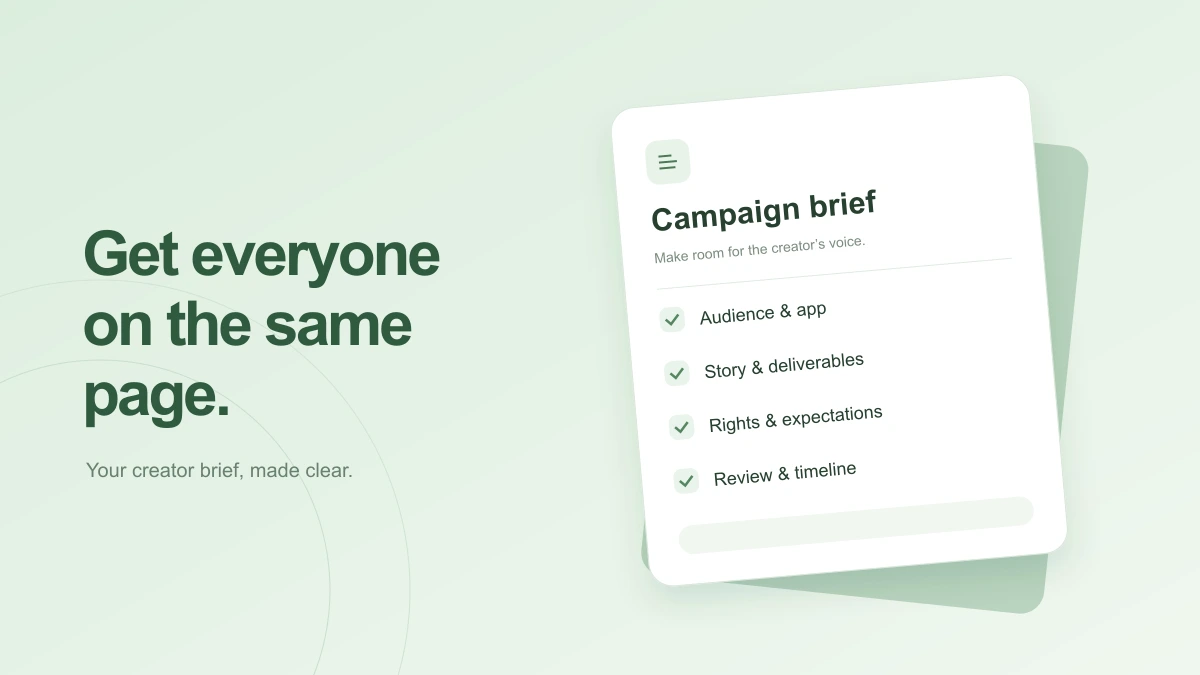
An influencer brief should tell a creator who the campaign serves, which problem the app solves, what they need to deliver, which claims they may make, how they must disclose the relationship, what rights you request, who approves the work, and how you will measure the agreed action. It should protect accuracy without scripting the creator's voice.
Copy this template, replace every bracketed instruction, delete irrelevant sections, and let the creator ask questions before either side agrees.
The brief is not the contract. The brief directs the creative job. The contract records obligations such as payment, rights, exclusivity, cancellation, and remedies after both parties agree. Keep unanswered commercial terms visible instead of letting a blank field become an assumption.
Start with evidence for creator fit
Record what you observed publicly, what you infer, and what only the creator can confirm. A large audience or a familiar topic does not prove fit.
| Evidence type | Useful record | Do not turn it into |
|---|---|---|
| Observed | Dated profile URL, recent relevant posts, typical format, disclosed partnerships | A claim about private audience demographics |
| Inferred | Why the creator's recurring subject may match the audience job | A verified endorsement or willingness to work |
| Creator-confirmed | Audience information, conflicts, availability, access needs, commercial terms | Permission to reuse content outside the agreed scope |
| Brand-verified | Product capability, approved claim, evidence owner, current landing page | A promise about results the product cannot guarantee |
Write the observation before the inference. “Three dated videos explain saved-content workflows” is inspectable. “Their audience will install our app” is a forecast, not evidence.
Copyable influencer brief
CAMPAIGN
[Campaign name]
[Brand and app]
[Responsible contact]

GOAL
[One observable campaign job]
[One primary viewer action]

AUDIENCE
[Who they are]
[What they are trying to do]
[What blocks them]
[Why this creator's audience fits]

PRODUCT TRUTH
[Problem the app addresses]
[Verified capability to demonstrate]
[First action inside the app]
[Claims the creator must not make]

CREATIVE DIRECTION
[Core message]
[Required facts]
[Optional angles]
[Tone and accessibility needs]
[Prohibited themes or unsafe demonstrations]

DELIVERABLES
[Platform and format]
[Quantity and duration]
[Required disclosure]
[Caption, link, tag, or code]
[Draft and publication dates]

RIGHTS
[Organic use]
[Paid use]
[Territory]
[Duration]
[Editing permission]
[Whitelisting or account access, if any]

REVIEW
[Who reviews]
[What requires approval]
[Number and scope of revisions]
[Compliance escalation route]

MEASUREMENT
[Primary metric]
[Link or attribution method]
[Reporting source and deadline]
[What the data cannot prove]
Define one campaign job
“Create awareness” is too vague. Choose an observable job such as introducing one app workflow to a specific audience, testing one creator angle, earning qualified visits to a landing page, or explaining a new feature.
Pair it with one primary action. Ask viewers to visit, try, save, join, or open. Do not ask one post to teach the entire product, create trust, drive installs, sell a subscription, and collect testimonials at once.
Describe the audience through a real task
Give the creator a person they can recognize:
| Weak description | Useful description |
|---|---|
| Women aged 18 to 34 | First-time renters trying to document apartment issues before move-in |
| Productivity users | Researchers who save articles but lose the next action |
| Fitness audience | Recreational lifters filming one set to compare technique |
Include what the audience already does, what frustrates them, and what would make them distrust the message. Do not add sensitive inferences that you cannot support or need.
Create a product truth block
List only verified capabilities the creator can show. For each capability, include the action and boundary.
Example:
Verified: A user can import a public article link and create a task with notes.
Show: Paste one public link, review the generated task, edit the next action.
Do not claim: The app reads every paywalled source or completes the task automatically.
Do not ask creators to describe experiences they did not have. Do not supply scientific, health, financial, or performance claims without the evidence and review they require.
Separate required facts from creative freedom
Required facts can include the exact product name, disclosure, visible workflow, link, launch date, and legally reviewed claim. Let the creator choose their hook, story, phrasing, setting, and honest opinion within the agreed boundaries.
If every sentence is fixed, you are buying an advertisement performed by a creator. Label and review it accordingly.
Specify deliverables precisely
For each deliverable, define:
- platform and account;
- format, orientation, and approximate duration;
- whether disclosure must appear in audio, video, caption, or all three;
- required product view or demonstration;
- caption, link, tag, and posting window;
- accessibility requirements such as captions and readable on-screen text;
- draft, feedback, approval, and publication dates.
Do not use “one TikTok plus stories” as the complete scope. Define how many story frames, how long links remain active, and whether reposting belongs to the rights grant.
Keep these decisions in one row for each deliverable. A campaign-wide disclosure or rights paragraph can hide a contradiction. For example, a Reel may need spoken and on-screen disclosure while a static post needs disclosure in the visible caption; a paid cutdown may have a 30-day rights term while the creator's organic post has no brand reuse. If the date, disclosure, claim source, approver, revision scope, and measurement method are not connected to the same deliverable, the team cannot tell which decision applies.
Use three explicit states for claims, rights, revisions, and commercial terms:
| State | Meaning | Next action |
|---|---|---|
| Unknown | Nobody with authority has confirmed the decision | Keep it visible as a blocker or contract question |
| None | The responsible people explicitly agreed that no item applies | Record who confirmed it; do not leave a blank |
| Agreed | The parties settled the decision | Record the exact scope, owner, and date where relevant |
Worked deliverable row
| Decision | Filled example |
|---|---|
| Platform and format | One 30-second vertical Reel with accurate captions |
| Product evidence | Screen recording of one verified public-link import workflow |
| Required fact | “The task remains editable before acceptance,” linked to the current claim record |
| Forbidden claim | No promise that the app reads every page or guarantees productivity |
| Disclosure | Approved words spoken in the video, visible on screen, and repeated in the caption |
| Dates | Concept, draft, feedback, approval, and publication each have an owner and date |
| Rights question | Whether the brand may repost organically for 30 days in one named market |
| Measurement | Qualified landing-page visits from the agreed link; a click does not prove an install |
This example is deliberately bounded. Change it to match the actual platform, market, product, and agreement.
Put disclosure beside the deliverable
The FTC's influencer guidance says a material connection can include payment, free or discounted products, employment, and personal or family relationships. It also says disclosure should appear with the endorsement, remain hard to miss, and use clear language.
Record the applicable market and obtain legal review when needed. Platform tools may help, but they do not replace your responsibility to assess whether people will understand the relationship.
Define rights without hiding them
Separate:
- the creator's organic post;
- the brand's organic repost;
- paid amplification;
- use from the creator's account;
- edits, cutdowns, translations, and still frames;
- territory and duration;
- exclusivity and category;
- archival use after the license ends.
Do not write “all rights forever, everywhere” as a default. Ask only for the use you can explain and value. Rights, compensation, and approval should agree in the final contract.
Create a review process
Name one decision-maker. Define what the brand reviews: factual accuracy, required disclosure, legal restrictions, safety, product presentation, and the agreed deliverable. Limit revisions and distinguish a correction from a new creative request.
Give the creator a direct route for questions. Late feedback and conflicting reviewers create avoidable errors.
Use one review sequence: creator confirms fit and conflicts, brand verifies claims and disclosure, the named approver returns one consolidated response, and the creator can decline a claim they cannot make truthfully. A factual correction is not the same as a new hook, reshoot, or usage request. Put that boundary and the number of included revision rounds in writing.
Keep common failures out of the brief
| Failure | Why it breaks the job | Repair |
|---|---|---|
| “Use your usual audience” | Hides who the campaign serves | Name the audience task and the public fit evidence |
| “One video, all rights” | Mixes creation, licensing, channels, territory, edits, and duration | Separate the deliverable from every requested use |
| Disclosure only in a profile | Viewers may not see it with the endorsement | Define clear placement for each deliverable and market |
| Required performance claim without evidence | Pressures the creator to repeat an unsupported claim | Link the source and owner or remove the claim |
| Three approvers in separate threads | Creates contradictory feedback and missed dates | Name one decision-maker and one review window |
| Install target measured with link clicks | Confuses a visit with a downstream event | Record the source, attribution window, and what it cannot prove |
| No cancellation path | Leaves reshoots, delay, illness, and product changes unresolved | Put these commercial questions in the contract |
Prepare the brief and creator research with OutDM
OutDM can turn a product URL into an editable audience brief, research matching public creator profiles, surface public contact routes when available, and prepare tailored outreach drafts for your approval. Start with the product URL, correct the generated audience and claims, then review each creator and exact message before you use a configured sending channel.
OutDM does not guarantee replies, posts, installs, sales, or creator fit. You approve what leaves your control.
For the broader campaign sequence, use our influencer marketing strategy for apps after the brief has one approved audience job and a truthful product demonstration.
Measure without overstating attribution
Choose metrics that match the campaign job:
- delivered and approved assets;
- views or watch time reported by the platform;
- qualified landing-page visits;
- App Store or Play Store clicks;
- installs, trials, purchases, or subscriptions only when an authorized source reports them reliably.
Do not call a store click an install. Do not attribute every conversion during the campaign window to the creator. Record the source, window, model, and limitations.
Put each creator's campaign link and offer code into the brief itself. Our guide to measuring influencer marketing ROI for an app shows you how to set both up in App Store Connect and Play Console and how to read the result.
Final approval checklist
Confirm:
- one audience and one campaign job;
- verified capability and forbidden claims;
- exact deliverables and dates;
- disclosure language and placement;
- creator freedom and required facts;
- rights, territory, duration, edits, and paid use;
- compensation and payment process in the contract;
- accessibility requirements;
- reviewer and revision limit;
- measurement source and attribution boundary;
- cancellation, delay, and content-removal process;
- a public contact route and a human-approved outreach message.
A strong brief reduces ambiguity before it becomes conflict. It gives the creator room to communicate honestly and gives the brand a clear standard for accuracy, compliance, and delivery.
Build the brief and surface contract gaps
Use the Influencer Brief Builder after you have verified creator fit and product claims. Record every country with its ISO code. Keep audience country, creator or campaign country, contract governing-law country, and official-source country separate. A qualified reviewer needs a bounded role and an exact record from the tool's reviewed authority catalog. The catalog binds the document ID, HTTPS URL, and source country as one record; neither a typed hostname nor a reviewer's name can erase a country conflict. If the governing record is not in the catalog, keep the brief blocked and obtain qualified local review. Each deliverable then records a bounded channel, exact account URL, format, quantity, dimensions or duration, accessibility artifact, publication date, disclosure wording and placement, claim-to-source-to-owner chain, approver and review date, measurement window, metric, source, owner, and attribution model. The builder checks those relationships, not just their shape: social channels must use their native account host, video cannot use image-only alt text as its accessibility artifact, review must finish by publication, and measurement cannot finish before the post exists. Rights record the channel, territory, edit permission, duration in days, and owner. Revisions record a count, scope, and owner. Commercial fields use numeric amounts, ISO currency, tax treatment, payment days, caps, notice, kill-fee percentage, and removal window. A none decision needs a named confirmer and a bounded reason; otherwise leave it unknown. Unknown rights, revisions, and commercial terms lock export. Browser-local resume and version-two JSON preserve incomplete work for the next session.
The output is a planning artifact, not legal approval. Selecting a catalog record does not determine that it applies to the campaign. Confirm the governing market, platform rules, disclosure placement, claims evidence, and contract language with qualified reviewers before outreach.
Sources and method
- FTC: Disclosures 101 for Social Media Influencers
- FTC: The Endorsement Guides, What People Are Asking
We checked current organic results for influencer brief template and the narrower deliverables, rights, approvals, and measurement variant on September 4, 2026, in an English US context. We inspected the direct result pages and recorded their order, strongest sections, omissions, and URLs in the checked-in evidence matrix. Leading pages consistently covered campaign goals, deliverables, creative direction, disclosure, rights, and approval. This guide and tool add a dated observation-versus-inference record, explicit unknown, none, and agreed states, and independently auditable deliverable rows. The FTC sources govern the US disclosure statements here. Other markets need their own current rules and qualified review.
Keep building your campaign

Measure Influencer Marketing ROI for Your App
Measure influencer marketing ROI for your app: give each creator a tracked link or offer code, count paying customers, subtract every cost and compare.
Read the guide
Build an Influencer Contract Template With These 9 Clauses
Build your influencer contract template from a clause by clause checklist: deliverables, usage rights, exclusivity and the exact FTC disclosure wording regulators expect. Not legal advice.
Read the guide